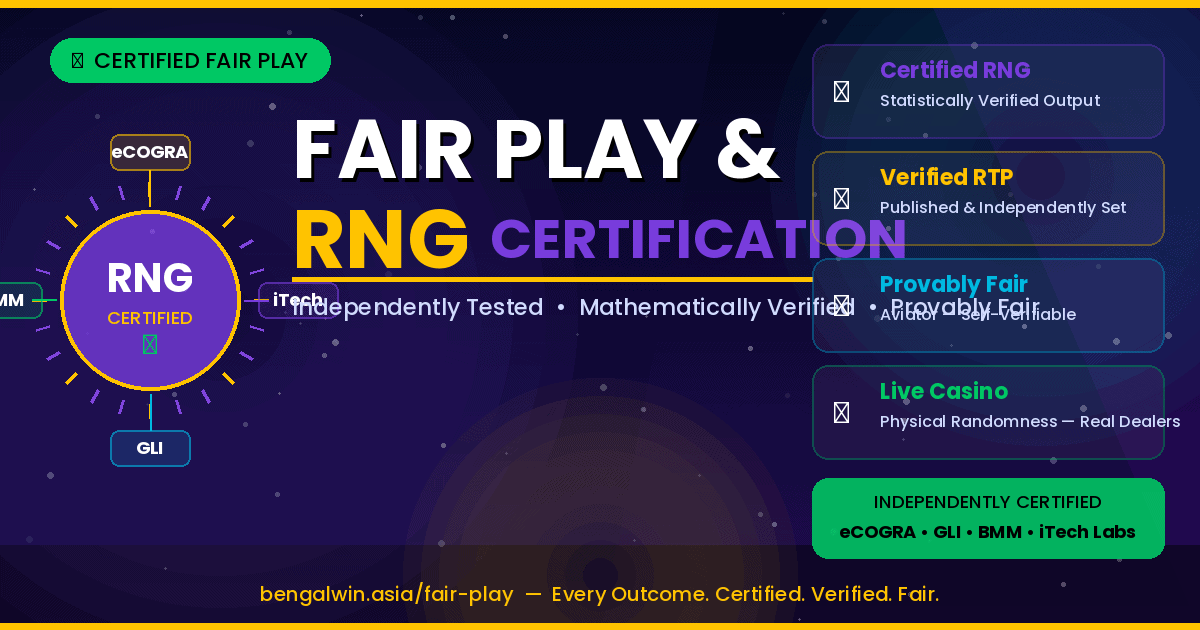

How Every Game Outcome at Bengalwin Is Guaranteed to Be Random, Fair, and Independently Verified
Effective Date: May 2026 Last Updated: May 2026 Applies To: All games available at bengalwin.asia Operator: Bengalwin License: Curaçao eGaming License Version: 2.0
The Question Every Serious Player Should Ask
Before you deposit money into any online casino, there is one question worth asking — and most players never do.
How do I know the games are actually fair?
It’s a completely reasonable question. You’re playing against a computer. You can’t see the cards being shuffled. You can’t watch the roulette wheel spin in front of you. You can’t observe the slot machine’s internal mechanics. The entire experience is digital, and digital systems can, in theory, be manipulated.
So how do you know Bengalwin ensures fair play & games aren’t rigged?
The answer is Random Number Generation — and the independent certification system built around it. This page explains how it works, what it means for every game you play at Bengalwin, and why the certification framework makes manipulation technically impossible rather than just contractually prohibited.
Read this once. It will change how you think about online gaming outcomes — and give you genuine confidence in every spin, hand, and bet you place at bengalwin.asia.

Table of Contents
What Is an RNG? The Plain-Language Explanation
RNG stands for Random Number Generator. In the context of online casino games, an RNG is a software algorithm that produces a continuous stream of random numbers — thousands per second — with no pattern, no predictability, and no external influence possible.
Here is how it works in practice:
When you press “Spin” on a slot game, the RNG algorithm has already generated millions of numbers in the background. At the precise millisecond you press that button, the algorithm captures the current number in the sequence and maps it to a specific outcome — a combination of symbols on the reels. The outcome is determined by where in the number sequence the algorithm happens to be at that exact moment.
Since the algorithm generates numbers continuously regardless of whether anyone is playing, the timing of your button press is effectively random in itself. You could press Spin a millisecond earlier or later and get a completely different outcome. The system is not waiting to calculate what to show you — it’s always running, and your interaction simply samples the current state.
This is why a genuinely certified RNG cannot be predicted, manipulated, or timed in any way that improves your outcomes. The randomness is structural — built into the mathematical foundation of the algorithm — not just a policy promise.
The Two Types of Randomness — True RNG vs Pseudo-RNG
There is a technical distinction worth understanding here because it’s relevant to how casino RNG certification works.
True Random Number Generators (TRNG)
True RNGs generate randomness from physical phenomena — thermal noise, atmospheric interference, radioactive decay, or similar non-deterministic physical processes. The randomness is genuinely unpredictable because it derives from the inherent uncertainty of physical reality.
True RNGs are used in cryptography and high-security applications. They are not typically used in online casino games because their output rate is too slow for the demand of a real-time gaming environment serving thousands of simultaneous players.
Pseudo-Random Number Generators (PRNG)
Pseudo-RNGs use mathematical algorithms that produce sequences of numbers statistically indistinguishable from true random numbers. They generate numbers at enormous speed — billions per second if needed — making them ideal for gaming applications.
The word “pseudo” sounds concerning, but it shouldn’t be. A properly designed and certified PRNG is mathematically random for all practical purposes. The sequence is so long and the pattern so complex that it cannot be predicted or reverse-engineered within any realistic timeframe — including by the casino operators themselves.
This is the critical point: Bengalwin cannot predict or influence the output of the certified RNG algorithms used in our games. Neither can game providers. Neither can any individual player. The outcome of every game is determined by mathematics that no party to the game can control.
Certified RNG — The Gold Standard
The online gaming industry uses certified PRNG algorithms — specifically PRNG implementations that have been independently tested, mathematically verified, and certified by recognized third-party testing laboratories to produce statistically random, unbiased outcomes.
Bengalwin’s games use certified PRNG algorithms from licensed game providers that maintain their certifications through ongoing independent audits.
What Is RTP — And Why It Matters
RTP stands for Return to Player. It is the percentage of all money wagered on a game that is mathematically expected to be returned to players over an infinite number of game rounds.
An RTP of 96% means that for every ৳100 wagered across all players on that game over a statistically significant number of spins, ৳96 is expected to be returned as winnings. The remaining ৳4 represents the house edge — the casino’s mathematical advantage.
What RTP Is Not
RTP is not a promise about individual sessions. It is a mathematical property of the game over millions of rounds — not a prediction of what will happen in your next 100 spins.
A game with 96% RTP can — and regularly does — pay out less than 96% in any given session, or significantly more. Individual sessions are governed by variance. The 96% figure emerges only when aggregated across enormous sample sizes.
Understanding this distinction matters because it prevents a common and costly misunderstanding: that a game is “due” for a payout. After all, it hasn’t paid recently, or you can predict when a machine is about to hit based on how long it’s been since the last win. Neither of these beliefs has any mathematical basis. Every spin is independent of the one before it.
RTP Ranges at Bengalwin
Games on the Bengalwin platform are sourced from licensed providers who publish and maintain certified RTP figures for every title. Typical RTP ranges by game category:
| Game Category | Typical RTP Range |
|---|---|
| Best Slots | 94% — 98% |
| Live Casino Games | 95% — 99.5% |
| Fishing Games | 95% — 97% |
| Global Poker | 97% — 99%+ (skill-dependent) |
| Lottery | 50% — 90% (varies by format) |
These figures represent the certified RTP ranges maintained by the game providers under their own licensing and certification obligations. Individual game RTP figures are typically available in each game’s information panel or help section.
Who Certifies Casino RNG Systems — And Why It Matters
The certification of online gambling RNG systems is produced by independent technical testing laboratories. These are organizations with no financial relationship with casino operators or game providers — their business model depends entirely on the credibility of their testing processes.
The most recognized testing laboratories in the online gaming industry include:
eCOGRA (eCommerce Online Gaming Regulation and Assurance)
eCOGRA is one of the most recognized independent testing and certification bodies in the online gaming industry. Established in 2003, eCOGRA audits and certifies the RNG systems, RTP values, and operational practices of online casinos worldwide. Their seal of approval is one of the strongest trust signals in the industry.
BMM Testlabs
BMM Testlabs is a global gaming test laboratory and technical expert that provides independent testing, certification, and compliance services for the gaming industry. BMM has tested and certified gaming systems in over 470 jurisdictions worldwide.
Gaming Laboratories International (GLI)
GLI is one of the largest gaming testing laboratories in the world, providing technical compliance testing and engineering services for land-based and online gaming. GLI certifications are recognized by gaming regulators across more than 480 jurisdictions.
iTech Labs
iTech Labs is an independent testing laboratory for online gaming systems. Their testing covers RNG certification, game mathematics verification, and compliance with international gaming standards across multiple regulated markets.
Technical Systems Testing (TST)
TST is a gaming test laboratory providing independent testing services, including RNG certification, RTP verification, and compliance testing for online gaming platforms globally.
What These Laboratories Actually Test
When a testing laboratory certifies an RNG system, the certification process includes:
Statistical analysis — The RNG output is subjected to a battery of statistical tests designed to detect any pattern, bias, or predictability in the number sequences produced. These tests include the NIST Statistical Test Suite, the Diehard Battery of Tests, and other recognized statistical frameworks designed to expose non-random behavior.
Algorithm review — The source code of the RNG algorithm is reviewed by the testing laboratory’s technical staff to verify that its mathematical properties meet the required standards for randomness and that no back doors, manipulation mechanisms, or predictability vulnerabilities exist.
Seed verification — The seeding mechanism of the PRNG (the initial value that starts the number sequence) is reviewed to ensure it is derived from a sufficiently unpredictable source and changes frequently enough to prevent sequence prediction.
Output analysis — The actual output of the RNG system in a live gaming environment is monitored and analyzed to verify that the statistical properties of game outcomes match the certified theoretical values.
RTP verification — The actual payout rates of games over millions of simulated rounds are compared to the published RTP figures to confirm they match within acceptable statistical tolerance.
Periodic re-certification — Certification is not permanent. Licensed game providers undergo periodic re-testing and recertification to maintain their certifications. Any software update to a game requires re-certification of the affected components.
How Bengalwin Ensures Fair Play Through Its Game Providers
Bengalwin does not develop its own games. Our game library is sourced entirely from licensed third-party game providers who are independently certified. This structure is important for player protection — it means the fairness of the games is verified at the provider level, not self-assessed by the casino.
Here is how the chain of accountability works:
- The game provider develops the game and its RNG system. They submit the complete system to an independent testing laboratory for certification. The laboratory tests the system and issues a certification confirming the RNG meets required standards.
- The game provider supplies the game to Bengalwin under a licensing agreement. The licensing agreement requires the provider to maintain their certifications and notify Bengalwin of any issues affecting game integrity.
- Bengalwin integrates the game and makes it available to players. We do not have access to the RNG code or the ability to modify game outcomes. We receive the same output that the certification laboratory tested — the unmodified, certified version.
- The certification laboratory continues periodic testing. The provider’s RNG certification is reviewed and renewed on a regular schedule. Any lapse in certification would require the game to be withdrawn from our platform.
This structure means the fairness of our games is verified by parties with no financial incentive to overlook problems. The testing laboratories are paid to find issues — their reputation depends on their thoroughness.
Our Certified Game Providers
Every game provider on the Bengalwin platform maintains independent RNG certification. Our certified provider network includes:
JILI Gaming holds RNG certification for its complete portfolio, including Super Ace, Boxing King, and Jili Fishing titles. JILI is one of the most-played game providers in South and Southeast Asia, with certifications recognized across multiple regulated markets.
JDB Games maintains certified RNG systems for its full catalog, including Treasure Bowl and its extensive fishing game portfolio. JDB holds certifications from recognized international testing laboratories.
Evolution Gaming is the world’s leading live casino provider and holds comprehensive certifications across dozens of regulated jurisdictions. Evolution’s live dealer games operate under physical randomness (real cards, real roulette wheels, real dice) supervised by certified dealing procedures — providing an additional layer of verifiability beyond pure algorithmic RNG.
Spribe Gaming holds certification for the Aviator crash game and its broader portfolio. Spribe’s provably fair system for Aviator deserves specific mention — we explain it in detail in the section below.
FA Chai maintains RNG certification for their full slot and fishing game portfolio. FA Chai games are particularly popular on the Bengalwin platform, and their certification is maintained through regular independent review.
Pragmatic Play holds certifications from GLI, BMM, and eCOGRA across its complete game catalog. Pragmatic Play is one of the most certified game providers in the industry with regulatory approvals in over 20 jurisdictions.
Additional slot titles on Bengalwin are sourced from other regional and international studios beyond the core lineup above, each carrying independent RNG certification consistent with the standards described in this article.
Provably Fair — The Next Level of Transparency
Some games on the Bengalwin platform go beyond standard RNG certification to offer a system called Provably Fair. This deserves special attention because it represents a genuinely different and higher standard of outcome verification.
What Provably Fair Means
In a standard certified RNG system, the fairness of outcomes is verified by the testing laboratory — a trusted third party that players must take on faith. The player cannot independently verify individual outcomes.
In a Provably Fair system, the player can independently verify that any specific game outcome was genuinely random and unmanipulated — using publicly available cryptographic tools — without relying on any third party at all.
How It Works
The Provably Fair mechanism works through cryptographic hashing:
- Before the game round begins, the server generates a random seed for that round and provides a hashed version of it to the player. This hash is a mathematical fingerprint of the seed — it proves the seed exists and was locked in before the game started, without revealing what the seed is.
- The player also contributes a client seed — a random value from their own side — that combines with the server seed to determine the outcome. Because the player’s seed is included in the calculation, the server cannot manipulate the result even if it wanted to — changing the outcome would require changing the server seed, which would invalidate the original hash.
- After the game round, the server reveals the original unhashed seed. The player can use publicly available hash verification tools to confirm that the revealed seed matches the hash they were given before the round. If they match, the outcome was determined by the seeds in play before the game started — meaning it could not have been manipulated.
Aviator by Spribe — Provably Fair in Practice
Aviator by Spribe is the most popular Provably Fair game on the Bengalwin platform. Every round’s crash point is determined by a provably fair algorithm combining server seeds and player seeds. The crash point hash for each round is published before the round begins, and players can verify any historical round’s outcome using Spribe’s public verification tool.
This means that for every Aviator round you’ve ever played on Bengalwin, you can go back and independently verify that the crash point was mathematically determined before the round started and was not manipulated during or after play. No other trust mechanism in gambling offers this level of individual outcome verifiability.
Live Casino Fair Play — A Different Kind of Verification
Live casino games at Bengalwin operate under a different fair play framework from RNG-based slots and table games. Because live dealer games use physical objects — real cards, real roulette wheels, real dice — the randomness comes from physical reality rather than software algorithms.
How Live Casino Fairness Is Maintained
- Physical randomness — A real human dealer shuffles real cards from a real shoe. A real roulette wheel spins with a real ball. The outcome is determined by physical processes that software cannot influence.
- Multi-camera oversight — Live dealer studios operate under continuous multi-angle camera coverage. Every card dealt, every wheel spin, and every dice roll is captured from multiple angles simultaneously, creating an auditable record of every game action.
- Certified dealing procedures — Dealers at licensed live casino studios are trained and monitored to follow certified dealing procedures. Regular audits verify that dealing procedures are being followed correctly.
- Shuffle verification — Card shoes in live casino games contain a set number of decks and are shuffled using certified procedures. The number of cards remaining in a shoe is tracked, and shoes are replaced after a set number of deals — preventing any possibility of card manipulation through selective dealing.
The combination of physical randomness, multi-camera oversight, certified procedures, and independent licensing makes live casino games at Bengalwin among the most transparently fair gaming experiences available in the online casino market.
What Fair Play Means for Sports Betting
Sports betting and online cricket betting at Bengalwin operate under a different fair play framework from casino games. Outcomes are not determined by RNG — they are determined by real sporting events.
Fair play in the sports betting context means:
What Bengalwin Cannot Do
This section exists to make something absolutely explicit that some players wonder about but rarely ask directly.
Bengalwin cannot see your next card before it’s dealt.
Bengalwin cannot change the outcome of a spin after you press the button.
Bengalwin cannot adjust the RNG output based on your betting patterns, account balance, or history.
Bengalwin cannot make a slot “hold back” a jackpot to pay it out at a more commercially convenient moment.
Bengalwin cannot turn off the RNG during specific sessions to generate a specific outcome.
None of these things is technically possible because Bengalwin does not have access to the RNG source code, the seed generation mechanism, or the outcome calculation process. We integrate the games. We do not control their mathematical underpinnings.
The certified RNG systems used by our game providers are black boxes — Bengalwin provides the gaming environment and the player experience. The fairness of the outcome itself is handled by systems we cannot access or modify.
This is not a marketing claim. It is how the technical architecture of certified online gaming systems works — and it is the reason independent certification by bodies like eCOGRA, GLI, BMM, and iTech Labs is meaningful rather than decorative.
Common Myths About Online Casino Fairness
Players sometimes arrive at Bengalwin carrying misconceptions about how online games work. Addressing these directly is part of our commitment to fair play.
Myth: “Online slots are programmed to pay out more when the casino needs more players.” False. RNG systems operate independently of business conditions. The algorithm generates random numbers continuously without any awareness of marketing goals, player numbers, or commercial targets.
Myth: “If I’ve lost a lot recently, I’m due for a win.” False. This is called the Gambler’s Fallacy and it is one of the most common and costly misunderstandings in gambling. Each game round is completely independent of previous rounds. A slot that hasn’t paid a jackpot in a million spins has the same probability of paying on the next spin as it did on the very first. Previous outcomes have zero influence on future outcomes in an RNG-based system.
Myth: “Casinos can switch between ‘hot’ and ‘cold’ modes on slot machines.” False. Certified RNG systems do not have modes. There is no switch, no temperature setting, and no operator control panel that changes outcome probability. The mathematical properties of a certified game are fixed and verified — they cannot be changed without triggering re-certification requirements.
Myth: “Playing at certain times gives better results.” False. Because the RNG generates numbers continuously and outcomes depend on the precise millisecond timing of your action, time of day does not influence outcomes. A spin made at 3 AM and a spin made at 3 PM on the same game have identical probability distributions.
Myth: “Using auto-spin gives worse results than manual spin.” False. Whether you press the spin button yourself or use auto-spin, the outcome is sampled from the same continuously running RNG at the moment the spin is initiated. Auto-spin does not alter the RNG output in any way.
How to Verify Fair Play Yourself
There are practical steps you can take to verify fair play at Bengalwin — without taking anyone’s word for it.
- Check individual game RTP — Most games display their RTP in the information panel accessible from within the game. If the published RTP matches the certified figure from the provider’s website, the game is operating as certified.
- Use Provably Fair verification for Aviator — If you play Aviator, Spribe provides a public verification tool where you can check any historical round’s outcome against its pre-game hash. This is the most direct form of outcome verification available in online gaming.
- Check provider certifications — The certification status of major providers like Evolution Gaming, Pragmatic Play, and JILI is publicly verifiable through the websites of testing laboratories, including eCOGRA, GLI, and BMM. Search for the provider name on the testing laboratory’s website to confirm the current certification status.
- Monitor your long-term results — Over a statistically significant number of sessions, your aggregate return should trend toward the certified RTP of the games you play. Short-term variance is expected and normal. Long-term results that significantly and consistently deviate from published RTP figures are worth investigating — but understand that thousands of sessions are required before the statistics become meaningful.
Reporting Suspected Game Irregularities
If you experience a game outcome that you believe is genuinely inconsistent with fair play — not a session where you lost more than expected, but a specific, documented outcome that appears mathematically impossible — here is how to report it:
Step 1 — Note the details immediately: game name, provider, time, stake, outcome, and your account balance before and after.
Step 2 — Contact Bengalwin support through live chat at bengalwin.asia or the Contact Us page within 24 hours of the incident. Include all details noted in Step 1.
Step 3 — Our technical team will review the game log for the reported round. Game providers maintain complete round-by-round logs that can be audited against the certified RNG output for that session.
Step 4 — Where a genuine technical fault is identified, the affected round is voided and the stake returned. Where the review confirms the outcome was within normal certified parameters, we will explain this clearly with reference to the game’s certified RTP and variance characteristics.
If you remain unsatisfied after Bengalwin’s internal review, the matter can be escalated to the Curaçao Gaming Control Board as the regulatory authority or to the relevant game provider’s certification laboratory.
Our Commitment to Ongoing Fair Play
Fair play is not a one-time certification — it is an ongoing operational commitment. Bengalwin’s fair play commitment includes:
- Sourcing games exclusively from certified, licensed game providers
- Maintaining only games whose certifications are current and in good standing
- Withdrawing any game from the platform that loses its certification for any reason
- Publishing accurate RTP information for all game categories
- Maintaining full game logs for independent audit purposes
- Cooperating with player investigations into suspected game irregularities
- Updating this page whenever our provider network or certification standards change
Fair play is the foundation on which everything else at Bengalwin is built. If the games aren’t fair, nothing else matters — not the bonuses, not the payment speed, not the cricket betting markets. We know that. And that’s why we built the platform around certified fair play from day one rather than retrofitting it as an afterthought.
Frequently Asked Questions (FAQ’S) on Bengalwin Fair Play and RNG Certification
Are Bengalwin’s casino games fair?
Yes. Every game on Bengalwin is sourced from independently certified game providers whose RNG systems are tested and verified by recognized third-party laboratories, including eCOGRA, GLI, BMM, and iTech Labs. Bengalwin cannot access or modify game outcome algorithms.
What is RNG in online casino games?
RNG stands for Random Number Generator. It’s a certified software algorithm that produces thousands of random numbers per second. When you press Spin, the current number in the sequence maps to a specific outcome. No party — including the casino — can predict or influence which number is selected at that exact millisecond.
What is RTP, and what does it mean for players?
RTP (Return to Player) is the percentage of wagered money a game is mathematically expected to return over millions of rounds. A 96% RTP game returns ৳96 for every ৳100 wagered across all players long-term. It is not a session guarantee — individual results vary significantly due to variance.
What is Provably Fair, and how does Aviator use it?
Provably Fair is a cryptographic system where players can independently verify any game outcome was genuinely random. Aviator by Spribe uses a hash of the server seed published before each round. After the round, you can verify the revealed seed matches the original hash — proving the crash point was set before play began and couldn’t be changed.
Which laboratories certify Bengalwin’s game providers?
Bengalwin’s game providers hold certifications from eCOGRA, GLI (Gaming Laboratories International), BMM Testlabs, iTech Labs, and Technical Systems Testing (TST). These are independent organizations with no financial relationship with casino operators whose business depends entirely on the credibility of their testing.
Can Bengalwin change game outcomes?
No. Bengalwin integrates certified games from licensed providers but does not have access to the RNG source code, seed generation mechanism, or outcome calculation process. Game outcomes are determined by certified algorithms that neither Bengalwin nor any third party can access or modify.
Are live casino games at Bengalwin fair?
Yes. Live casino games use physical randomness — real cards, real roulette wheels, real dice — not software algorithms. Outcomes are determined by physical reality under multi-camera supervision following certified dealing procedures. Evolution Gaming’s live studios operate under their own independent licensing, separate from Bengalwin’s platform oversight
Can I verify that Bengalwin’s games are certified?
Yes. For Aviator, use Spribe’s public hash verification tool to check any historical round. For other games, check each provider’s certification status on the eCOGRA, GLI, or BMM websites. Individual game RTP figures are displayed in each game’s information panel and can be compared against provider-published figures.